
Educational Jigsaw Puzzle Fun
More Games




Little pictures, big “I did it!” energy
You pick a picture, the pieces scatter, and the job is simple: build the scene back up one piece at a time. Educational-jigsaw-puzzle-fun is exactly that clean, satisfying jigsaw loop kids can understand in seconds, with themes that sneak in learning without turning it into a lesson.
The puzzles lean into bright, friendly illustrations. One round might be animals, the next might be nature, and then you’ll hit the classics: numbers and the alphabet. It’s the kind of game where finishing the image feels like a mini reward, and the topic of the picture becomes a quick prompt for kids to name what they see.
What makes it work is the pace. Even when a puzzle takes a little longer, it still feels like constant progress because you’re always moving pieces and tightening the picture. It’s calm, but it never drags.
How you play (and what to do first)
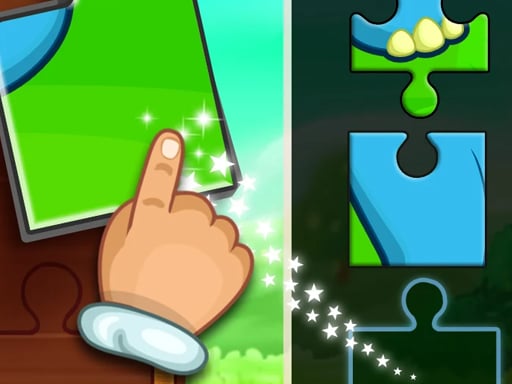
Everything is mouse-based, so the first move is literally just grabbing a piece and testing where it belongs. Click a piece, drag it across the screen, and drop it onto the board where you think it fits. When you’re right, the image starts locking into place visually.
The best way to start is to scan for “easy anchors.” Look for a piece with a big, obvious feature: a character’s eye, a bold number shape, the straight edge of a border, or a high-contrast corner of the illustration. Those pieces give the rest of the puzzle somewhere to connect mentally, even if the game isn’t forcing a strict “edge-first” method.
Most kids end up developing a rhythm after just a couple puzzles:
- Grab a piece with a strong color or symbol.
- Try it near the spot where that color appears on the board.
- If it doesn’t look right, slide it away and test the next likely area.
It’s hands-on problem solving with instant feedback, and that’s the whole point.
Difficulty: it ramps up the kid-friendly way
The game’s difficulty comes from puzzle selection and piece complexity. Some pictures are basically a warm-up: big chunky pieces, clear shapes, and a simple scene where every part looks different. Those tend to get finished fast, often in a couple minutes once a kid understands the drag-and-drop idea.
Then you hit puzzles where the art has repeating colors—big areas of sky, grass, ocean, or a background with the same shade across multiple pieces. That’s where the difficulty spikes, because kids can’t rely on color alone. They have to start paying attention to the tiny cues: the curve of a letter, the edge of a leaf, the angle of a number, or the way two lines continue across a seam.
There’s also a sneaky type of “hard” puzzle: alphabet and numbers scenes where multiple pieces include similar shapes. A “B” and an “8” can feel weirdly alike when you’re staring at puzzle fragments. Those rounds are great for learning, but they can take longer because kids double-check themselves more.
If you’re using this in a classroom or at home with siblings, the level curve is nice because it’s self-selected. A younger kid can stick with easier images, while an older kid can pick the ones with busier scenes and more lookalike pieces.
The part that catches people off guard
The biggest surprise is how often “almost correct” placements slow kids down. A piece might look like it fits because the colors match, but the outline is just slightly wrong. Kids will try to force it by moving it around the same area again and again.
A quick fix is to teach a simple rule: if you’ve tried the same spot twice and it still looks off, move on. Put that piece aside and place two or three other pieces first. In this game, filling in nearby pieces often makes the correct spot obvious because you start seeing the real boundaries of the picture.
Another thing: backgrounds are the trap. Pieces from the background feel interchangeable at first, so kids can get stuck “hunting” without progress. When that happens, it helps to switch targets and build a recognizable object instead—an animal face, a letter, a big number, or a bright shape. Once the main object is done, the background becomes a lot easier because there are fewer gaps left to guess.
If you’re playing alongside a kid, try calling out what you’re doing out loud: “I’m looking for the piece with the top of the A,” or “This piece has whiskers, so it probably goes near the cat.” That tiny bit of narration turns random dragging into real thinking.
Who it’s best for
This is a great fit for preschoolers and early elementary kids who like quick wins. It rewards patience, but it doesn’t punish mistakes, so kids can experiment without feeling like they’re “losing.”
It also works well as a short activity between bigger tasks. One puzzle can be a clean reset—something focused that still feels like play. Parents usually like it for the fine-motor practice (click, drag, release), and educators like it because the pictures naturally lead to quick prompts: name the animal, find the letter, count the objects, spot the number.
And honestly, it’s a solid “together” game. One person can search for edge-like pieces while the other builds the main picture. When the final piece drops in and the image clicks into place, kids react like they just finished something huge. That moment never gets old.
Read our guide: The Best Puzzle Games Online
to leave a comment.