
Anime Girls Memory Card
More Games


Quick overview
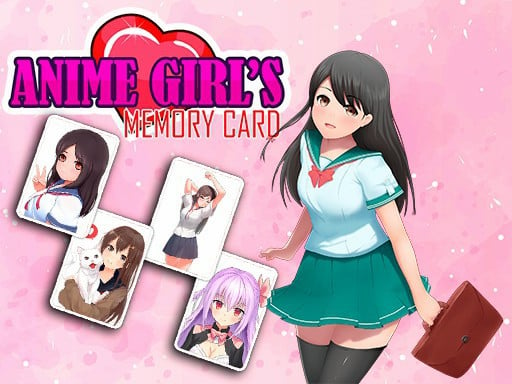
You’re flipping facedown cards to find matching pairs. That’s the whole game. The only real “feature” is the anime girl artwork on the cards, and the fact that the board gets bigger as you move through levels.
Each turn is the same: pick two cards, see what’s under them, and hope they match. If they do, the pair disappears and the board gets a little easier to read. If they don’t, they flip back and you’re expected to remember where they were.
Most levels are short once you know what you’re doing. Early boards can be cleared in under a minute; later ones can easily take 3–5 minutes if you’re guessing or clicking too fast to actually memorize anything.
Full controls breakdown
It’s mouse or touch only. No keyboard shortcuts, no fancy menus to learn. You click or tap a card to flip it over.
The game locks you into a two-card rhythm: first flip reveals one image, second flip reveals another. After the second flip, one of two things happens: the cards vanish as a matched pair, or they stay visible briefly and then turn facedown again.
Practical control detail: don’t spam clicks. If you start clicking a third card while the game is still resolving a mismatch, you’ll misclick, lose track of what you just saw, and basically waste your own time.
Click/tap: flip a card
Flip two cards: attempt a match (pair clears if identical)
Clear all pairs: level ends
Level progression: what actually changes
The difficulty isn’t “smarter enemies” or anything. It’s more cards. You start with a small grid where you can brute-force it and still finish. Then the grid expands, and the game starts punishing anyone who isn’t keeping a mental map.
New images show up as you progress, so you can’t rely on recognizing “that one face” from the last board. On later levels, you’ll also run into art that’s similar in color and composition (same hair color, similar outfits), which sounds like a small thing until you realize you’re mixing up two different cards because they both have blue backgrounds.
There’s a noticeable spike once the board reaches the point where you can’t keep everything in short-term memory. For most players, that’s around the first “big” board where you’re flipping for a while before you see the second copy of anything. At that stage, random guessing balloons your number of misses and the level drags.
Progress is basically: clear board, get a bigger board, repeat. If you want to “get better,” you’re improving your consistency and your method, not unlocking tools or power-ups.
Strategy and tips (so you’re not just guessing)
The best habit is boring: build a map. When you flip a card, don’t just look at the character—note the position. Top row, third from the left. Bottom corner. Whatever you need. People fail at this game because they recognize the image but forget where it was.
Start with a sweep pattern. For example, work left-to-right across the top row, then the next row, and so on. On a medium board, this alone cuts the “I already saw this… somewhere” problem in half because you’re feeding your memory in an organized way instead of random clicking.
When you get a mismatch, your next move should usually be information-first, not hope-first. If you just saw Card A (say, pink hair) at position 2,5 and Card B (say, black hair) at position 4,1, don’t immediately start hunting for pink hair by clicking random cards. Flip a new unknown card in a spot you haven’t checked recently, then use the second flip to cash in a known match if it appears.
Use corners and edges as “anchors” you remember faster.
If two cards look similar, focus on one detail (hair clip, eye color, background icon) and lock that in.
On bigger boards, it’s normal to spend the first 10–15 flips just scouting and collecting positions.
Common mistakes that waste your time
First mistake: clicking like it’s a slot machine. Fast flipping feels productive, but it’s the opposite. If you aren’t giving your brain a second to tag the image with a location, you’re not “playing,” you’re just creating random outcomes until you get lucky.
Second mistake: treating every revealed card as a potential match right away. Early on, sure, because the board is tiny and matches happen constantly. Later, you need to accept that most of your early flips are reconnaissance. If you keep trying to force matches before you’ve seen enough of the board, you’ll rack up repeated misses on the same few positions.
Third mistake: mixing up near-identical art. This game uses anime illustrations that can share colors, poses, and framing. If you only remember “blue-haired girl” and not “blue-haired girl with a red ribbon,” you will flip the wrong “match” over and over. That’s not bad luck; it’s sloppy memory.
Last one: forgetting what the game is asking for. It’s pairs. Two cards. Some people unconsciously start hunting for “sets” because they’ve played other matching games. Here, once you find the second copy, take the match immediately and remove it. Leaving known pairs on the board just increases clutter and future confusion.
Who this works for (and who should skip it)
This is for people who want a plain memory match game and like anime art. If you’re here for mechanics, depth, or anything beyond “flip and match,” you’ll run out of things to discover pretty quickly.
It also works if you want something low-pressure that you can play in short bursts. Even the tougher levels aren’t complicated—they just demand attention. If you’re distracted or multitasking, you’ll feel like the game “got hard,” when really you just stopped tracking positions.
Skip it if anime art isn’t a draw for you, because the gameplay alone is as simple as it gets. And if you hate repetition, the loop is the loop: bigger board, more pairs, same rules.
Quick Answers
Is there a timer or score?
Some versions track time and/or points based on matches and speed, but the main win condition is always the same: clear every pair to finish the level.
What’s the fastest way to beat big boards?
Stop guessing. Use a consistent sweep (row by row), memorize positions, and treat the first chunk of flips as scouting so matches come from memory instead of luck.
Read our guide: The Best Puzzle Games Online
to leave a comment.