
Empire.io Ndash Build and Defend Your Kingdoms
More Games


Quick overview
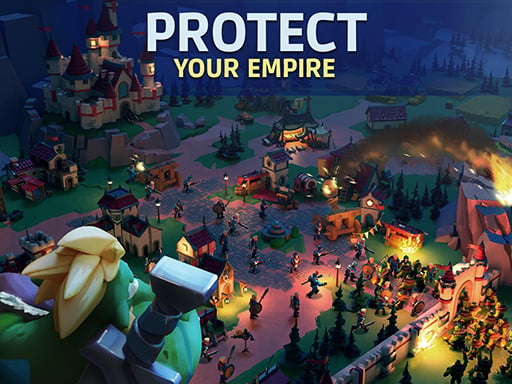
You’re building a small kingdom on an isometric map while waves of zombies keep testing the edges of your territory. The core loop is split between spending resources on buildings and upgrades, then using archers and trained units to stop incoming raids before they reach your stockpiles.
It plays like a light RTS with tower-defense pressure. The map view stays fairly zoomed out, so most decisions are about placement, timing, and which upgrades to prioritize rather than precise unit micro. When other players are in the same space, the threat list expands from “hold the line” to “hold the line while staying strong enough to deter opportunistic attacks.”
Runs tend to settle into a rhythm after the first few minutes: build, research, train, defend a wave, then expand again. The game pushes you toward steady growth, but it punishes overexpansion if it leaves key approaches under-defended.
Controls and interface, in detail
Empire.io is primarily mouse-driven. Most actions come from selecting something on the map (a building, a construction spot, a unit group) and then choosing an action from a context panel or a row of buttons.
Building and upgrading is handled through build menus and placement previews. You choose a structure, place it on valid terrain, and confirm the placement. Upgrades work the same way but usually come from clicking an existing structure and selecting an upgrade tier. A practical detail: the game generally makes you pay attention to what’s being upgraded, because upgrading the wrong economic building early can delay your first real defensive spike by a full wave.
Units and combat are controlled by selection and commands. Click a unit or drag-select where available, then issue move or attack orders by clicking a target location or enemy. Archers are your most obvious defensive tool early, but they still need sensible positioning; leaving them behind buildings where their line of fire is blocked wastes their DPS during the parts of a wave that matter.
Heroes, research, and progression menus are accessed through dedicated icons. Heroes typically behave like high-impact units with better stats and special usefulness in tight defenses. Research is usually a timed investment that pays back over multiple waves, so it’s something you queue when your defenses can survive without immediate spending.
The UI also references longer-term systems like a “deck,” arenas, and a Great Hall. In practice, those function as meta-progression layers: you assemble a loadout of options, climb through tougher match contexts, and unlock broad stat or building boosts through the Great Hall.
Progression: early setup to late pressure
The early stage is about not dying while your economy comes online. Your first build decisions set the pace: you want enough production to keep upgrading, but you also need a minimum defensive baseline before the first real zombie surge. Many players feel the first noticeable difficulty bump after a couple of waves, when zombies start arriving in denser packs and take longer to burn down with only basic archers.
Midgame is where the map starts to feel crowded with priorities. You’re upgrading facilities, starting research, and training more varied troops while also paying attention to approach angles into your city. This is usually where the “tower defense” part becomes more positional: a wall line that worked when enemies were sparse can fail once a wave stacks up and starts leaking around a corner.
In matches that include active human opponents, the midgame is also when scouting and deterrence matter. If your defenses are visibly pointed only at the zombie lanes, another player can pressure your resource side and force you into spending on military instead of infrastructure. A common pattern is that the first serious PvP pressure shows up right after you invest in a big upgrade, when your resource bank is low.
Later stages lean on scaling: higher-tier troops, heroes, and accumulated upgrades from the Great Hall-style systems. The difference between surviving and collapsing often comes down to whether you built a defense that can keep firing while you’re spending elsewhere, because late waves can overlap with moments where you’re busy managing training queues and repairs.
Strategy notes and practical tips
Defense placement matters more than raw count. Archers and defensive points work best when they can focus fire into a choke. A reliable approach is to build so that enemies are funneled into one or two lanes, then stack your highest damage coverage there instead of spreading everything evenly around the city.
Research pays back, but only if you can survive the next wave without the resources you spent. If a wave timer is close, it’s usually better to spend on immediate defense (extra units or a key upgrade) and start research right after the wave breaks. A lot of losses happen when a player starts a long research timer and then can’t afford the defensive upgrade that would have prevented the next breach.
Heroes should be treated as problem-solvers, not decoration. Put them where a wave is most likely to leak through, especially at corners and near resource buildings. In many sessions, a single well-placed hero can stabilize a defense that’s otherwise underbuilt, buying you time to finish a crucial upgrade.
When playing with allies, specialization tends to work better than everyone doing the same thing. One player leaning into economy and upgrades while another invests earlier in troop production can smooth out the midgame. If your group spreads out too much, you often end up with multiple half-defended settlements instead of one strong area that can actually hold a concentrated push.
- Build toward chokepoints; don’t ring the whole city with thin coverage.
- Spend before wave spikes: upgrades just after a wave are safer than upgrades right before one.
- Keep at least one flexible unit group to respond to leaks instead of committing everything to static defense.
Common mistakes that cost runs
The most common error is overbuilding economy early and assuming archers will cover everything. That works for the light waves, then fails abruptly once enemy density increases. The result is usually a chain reaction: a breach hits resource structures, income drops, and suddenly you can’t afford the defenses you needed in the first place.
Another frequent issue is poor firing lines. Because the view is isometric and buildings take up space, it’s easy to place defensive units where they technically “guard” an area but don’t actually shoot effectively. If your archers are spending time repositioning or are blocked by structures, the wave lasts longer, and longer waves increase the chance of leaks.
Players also tend to start too many long upgrades at once. Queuing a facility upgrade, a research project, and troop training simultaneously can leave you with no buffer. In this game, being resource-poor right as a wave starts is often worse than being slightly under-upgraded, because you lose the ability to react.
In multiplayer contexts, ignoring other players until it’s too late is a predictable way to lose territory. If you never invest in deterrence—basic troop presence and visible defensive coverage—someone else can choose their timing and hit you when you’re weakest, typically right after you’ve upgraded an important building.
Who it works for
This fits players who like incremental base growth with periodic “tests” that force you to prove your layout works. The moment-to-moment actions are mostly selection and planning, so it suits people who prefer management and timing over high-speed control.
It also works for players who like multiplayer strategy in small doses. Alliances and shared pressure create real decision points—how much to invest in defense versus expansion—without requiring constant chatting or heavy coordination every second.
Players who want pure, dense RTS combat may find it slower, especially in the early minutes when you’re setting up production and defenses. On the other hand, if you like watching a plan hold under pressure, the later waves and mixed threats (zombies plus human opportunists) are where the game is most consistent.
Read our guide: The Best Strategy Games in Your Browser
to leave a comment.